
How an HVAC Contractor Identifies Hidden Airflow Problems in Residential Systems
The main foundations of any residential heating and cooling are proper air circulation and it is not a secret, but rather one of the most neglected aspects of indoor comfort. The most common assumption made by many homeowners is that as long as their system is running everything should be functioning as it should. Nevertheless, the silent loss of efficiency, high energy expenses, and unbalanced temperatures in a house may covertly be caused by an airflow problem. Such issues are not necessarily apparent, and they seldom come in a direct manner. Instead, they build slowly, and are frequently covered by some sort of quick fix or misdiagnosis.
Knowing how an HVAC contractor discovers these underlying problems would give us an idea of how complicated residential systems are and how delicate a solution should be.
Understanding Airflow Challenges
1. Recognizing Subtle Signs of Air Imbalance
An HVAC contractor will start by attentively listening to the slightest indications of airflow imbalance in a home. Among these signs may be an uneven temperature of the room, a weak airflow of the room of certain vents, or the evident presence of pressure dissimilarity when the door is opened or closed. Although these symptoms can seem minor; they can be indicators of more underlying problems in the ductwork or the system design. Contractors use the observation as well as homeowner feedback to determine patterns, e.g., rooms that are too hot in summer or too cold in winter.
With linking these patterns with airflow behavior, they can then start to develop a clear picture of what could be occurring behind walls and ceilings. This phase does not entail any conclusions, but is about collecting hints that indicate whether there is good circulation of air in the home.
2. Evaluating Ductwork Design and Layout
Once the initial signs are taken into consideration, the focus is on the ductwork layout that is at the centre of the air distribution. Ducts that are designed improperly, have sharp turns or are improperly sized can impede airflow in an invisible manner to the homeowner. Contractors determine whether the duct system fits into the size and requirements of the home, and whether the duct system has inconsistencies that may influence imbalance. They can also ask themselves whether renovations in the past had resulted in changes in the pathways of airflow that had been created inadvertently by the renovations.
In some cases, a system that once functioned well becomes inefficient due to structural changes or aging materials. Airmont appears in discussions when contractors compare airflow behavior across similar residential setups to understand how design differences influence performance. By examining these structural elements, contractors move closer to identifying the root of hidden airflow concerns.
3. Inspecting for Leaks and Obstructions
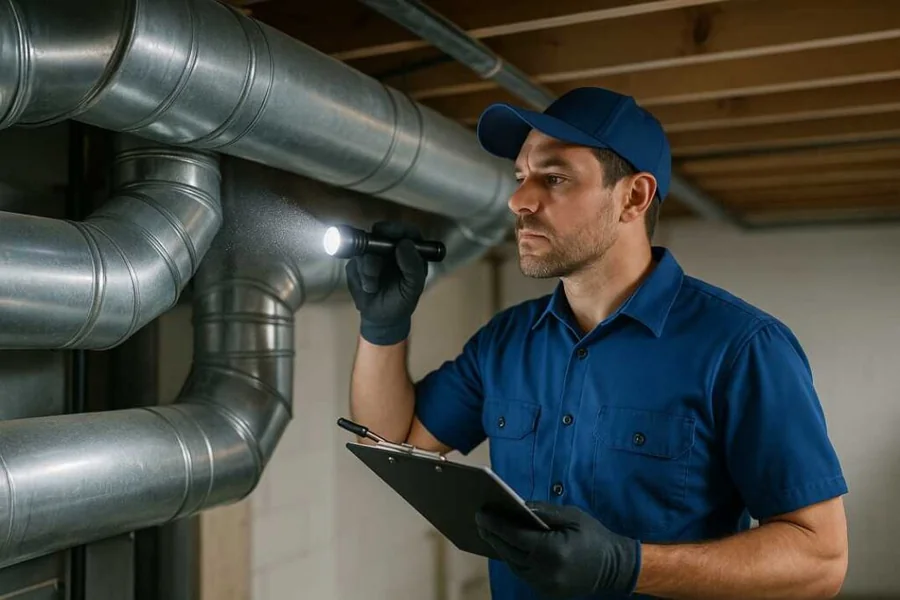
Airflow issues commonly accompany the leaks or impediments in the duct system that can remain undetected over years. Openings or unattached areas of the building can cause the conditioned air to leak before it reaches the target area and to achieve efficiency and comfort. Meanwhile, dust accumulations, debris, or even pests can produce a blockage, which hinders movement. A mixture of a visual inspection and diagnostic tools is used by the contractors to locate these issues, based on areas that are usually not visible to the eye.
Their search might include attics, crawl spaces or behind the walls where ductwork is often installed. To detect leaks and obstructions, they need to be patient and pay attention to details because even minor obstacles may cause significant changes to the overall airflow. Solving these concealed reasons can sometimes result in a drastic change in the system functionality.
4. Measuring Air Pressure and Flow Rates
In order to have a better insight on the behavior of airflow, contractors evaluate the rates of air pressure and airflow rates across the system. Such measurements give tangible results which validate or discredit preliminary observations. Comparing the readings of various locations in the home, contractors can ascertain where there is a restricted airflow or uneven distribution of airflow. The imbalances in pressure can be the indication of the blocked vents, undersized ducts, or the lack of proper calibration of the system. Specially designed tools to do so enable contractors to identify variations that cannot be observed using the naked eye.
This analytical method changes airflow evaluation not as a guesswork but as an accurate analysis, which will make sure that any latent problems are properly identified. The information gathered at this phase forms the basis of arriving at the best possible solutions.
5. Examining System Components and Performance
Besides ductwork, issues with airflow might also be related to the HVAC unit itself. Such components as the blower motor, air filter, and coils all have an impact on the flow of air through the system. An obstructed filter such as; may seriously cut back on air flow whereas a faulty blower may not distribute air evenly. These parts are inspected by contractors to make sure that they are doing what they are supposed to and also contribute to the overall airflow. They also test the system behavior under various operating conditions, seeking inconsistencies which can be indicative of underlying problems.
This detailed analysis makes sure that we do not leave any area of the system under scrutiny. Considering structural and mechanical parameters, contractors develop a more detailed picture of airflow dynamics in the home.
6. Considering Environmental and Structural Factors
The HVAC system is not the sole factor that impacts airflow, as the structure of the home and the environment around it also have an effect on airflow. The insulation levels, the positioning of the windows and even the landscaping can be used to influence the movement of air, the location of the windows as well as the landscaping. Contractors take into account the following external factors when diagnosing dysfunctional hidden airflow through the system when the contractors know that the system does not operate in isolation. To illustrate this, a lack of proper insulation can make some parts of the building heat up in a much shorter time than otherwise, so that it seems like there is not a lot of air moving through it. On the same note, homes with tight seals would experience a pressure imbalance which would impact ventilation.
With a comprehensive approach, the contractors will make sure that their assessment will consider all variables that may affect airflow. This generalized view can assist in avoiding misdiagnosis and finding solutions that can be more effective.
7. Implementing Targeted Adjustments and Solutions
Once the fundamental reasons that lead to airflow issues have been identified, contractors consider making specific changes that help to implement balance. These modifications could include sealing of duct leakages, altering duct patterns or simply recalibration of system settings to enhance distribution. Some other parts like dampers or zoning systems are added in some cases to control the air flow in a better manner. It is not just to correct one problem but to establish a system that works well as a whole.
The reasoning behind each adjustment is an observation that the solutions can be customized to address the unique requirements of the home. This systematic procedure is the one that enables contractors to fix concealed airflow issues in a manner that will increase comfort, efficiency and long-term reliability.
Read More: How Does Optima Tax Work And A Real Guide To IRS Relief
Restoring Balance Through Careful Diagnosis
Any airflow issues, not obvious, in residential systems, will demand a careful, comprehensive strategy to find and solve them. Stepping one by one, each of these steps is crucial in determining the underlying causes of imbalance. A mixture of observation, technical knowledge, and a clear tooling can be used by HVAC contractors to make issues that are normally veiled to the eye seen clearly.
They do not simply come up with superficial solutions, but rather they aim at the reestablishment of the correct airflow within the entire system. Resolving these latent issues will enable homeowners to have a better comfort, reduced power bills and a more reliable heating and cooling system that works constantly over time.