
Teen Crime Rates Vary Thirtyfold Across America as Serious Juvenile Offenses Rise
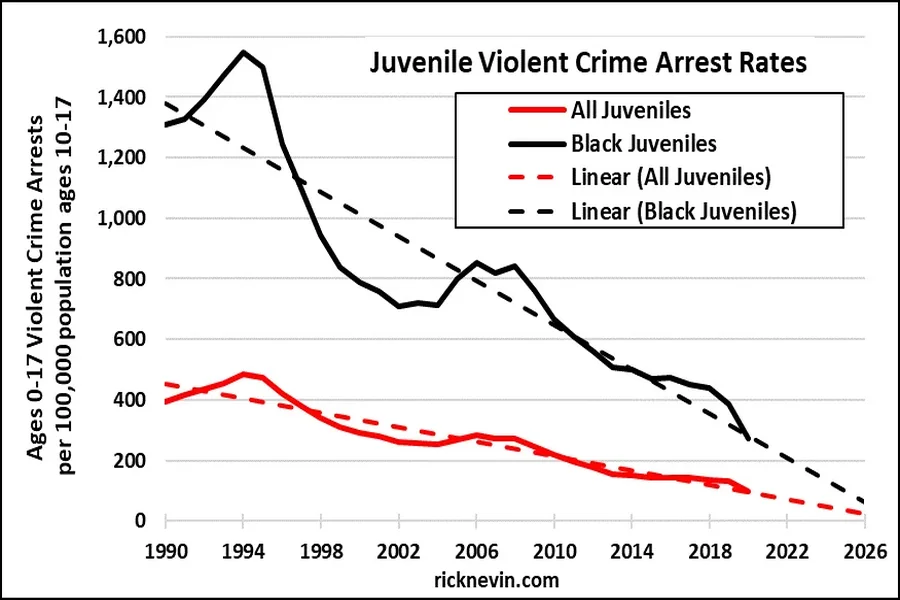
The likelihood that a young person will be arrested, detained or prosecuted varies dramatically depending on where the offense occurs.
A national analysis by Simmrin Law Group found that the District of Columbia recorded 45 juvenile arrests per 1,000 youth ages 10 to 17, the highest rate in the country. Vermont recorded just 1.5 arrests per 1,000 youth, creating a thirtyfold gap between the highest and lowest jurisdictions.
The geographic divide appears alongside another major shift in juvenile justice data. Total delinquency cases remain substantially lower than they were a decade ago, but several serious offenses are moving upward. Criminal homicide cases increased 80% between 2019 and 2023, motor vehicle theft cases rose 73% from 2014 to 2023, and aggravated assault cases climbed 35%.
At the same time, youth incarceration has fallen 75% since 2000, showing how fewer young people are being placed in secure facilities even as some offense categories become more severe.
Juvenile Crime in America at a Glance
- National juvenile arrest rate: approximately 15 per 1,000 youth
- Highest rate: District of Columbia at 45.0
- Lowest rate: Vermont at 1.5
- Juvenile delinquency cases in 2023: 653,800
- Juvenile facility residents in 2023: 29,314
- Decline in youth incarceration since 2000: 75%
- Increase in criminal homicide cases from 2019 to 2023: 80%
- Increase in motor vehicle theft cases from 2014 to 2023: 73%
- Teen drivers under the influence in fatal crashes, 2020 to 2024: 1,871
- Teen reckless drivers involved in fatal crashes: 286
- Youth held in adult jails in 2023: 2,000
- Youth serving sentences in adult prisons: 513
The Highest and Lowest Juvenile Arrest Rates
The highest-rate jurisdictions were concentrated primarily in the South and Southwest.
| Rank | State or District | Arrest Rate per 1,000 Youth |
|---|---|---|
| 1 | District of Columbia | 45.0 |
| 2 | Louisiana | 35.0 |
| 3 | Nevada | 32.0 |
| 4 | Delaware | 30.0 |
| 5 | Alabama | 28.0 |
| 6 | Arizona | 27.0 |
| 7 | Missouri | 26.0 |
| 8 | South Carolina | 25.0 |
| 9 | Oklahoma | 24.0 |
| 10 | Texas | 23.0 |
The 10 lowest rates were generally found in rural and Northeastern states.
| Rank | State | Arrest Rate per 1,000 Youth |
|---|---|---|
| 1 | Vermont | 1.5 |
| 2 | Idaho | 2.0 |
| 3 | Montana | 2.5 |
| 4 | New Hampshire | 3.0 |
| 5 | North Dakota | 3.5 |
| 6 | South Dakota | 4.0 |
| 7 | Rhode Island | 4.5 |
| 8 | Maine | 5.0 |
| 9 | Hawaii | 5.5 |
| 10 | Wyoming | 6.0 |
Every jurisdiction in the top 10 exceeded the national rate of approximately 15 arrests per 1,000 youth. Every state in the bottom 10 recorded a rate below half the national average.
The District of Columbia’s rate exceeded the national average by 200%. Louisiana’s was approximately 133% higher, while Nevada’s was about 113% higher.
Arrest figures do not measure offending alone. They may also reflect differences in police activity, legal definitions, school discipline, diversion availability and whether local systems formally process or redirect lower-level cases.
Court Caseloads Fell for Years Before Rebounding
Juvenile courts handled approximately 653,800 delinquency cases in 2023.
| Most Serious Offense Category | Cases |
|---|---|
| Person offenses | 255,500 |
| Property offenses | 178,900 |
| Simple assault | 158,000 |
| Public order offenses | 149,900 |
| Drug law violations | 69,500 |
Between 2005 and 2021, all major categories declined by at least 63%.
- Property cases fell 79%.
- Public order cases fell 78%.
- Drug cases fell 75%.
- Person cases fell 63%.
After 2021, those categories increased by 39% to 59% through 2023.
That reversal is one of the clearest recent changes in the data. It indicates that juvenile court systems processed substantially more cases after pandemic-era lows, even though overall caseloads remained below earlier levels.
Total delinquency cases were still 39% lower in 2023 than in 2014.
Traditional Property Crimes Declined, but Vehicle Theft Rose
Several offenses associated with earlier juvenile crime trends continued to fall over the decade.
| Offense | Change, 2014 to 2023 |
|---|---|
| Larceny-theft cases | 61% decrease |
| Liquor law violations | 59% decrease |
| Burglary cases | 49% decrease |
| Robbery cases | 12% decrease |
Arrest data showed even steeper declines among people under 18:
- Burglary arrests fell 68%.
- Larceny-theft arrests fell 65%.
- Robbery arrests fell 24%.
Motor vehicle theft moved in the opposite direction, increasing 73%.
Aggravated assault cases rose 35%, while criminal homicide cases increased 80% from 2019 through 2023. Juvenile homicide arrests rose 22% during that shorter period.
The result is a juvenile crime landscape with fewer conventional property and status offenses, but greater concern around a narrower set of serious crimes.
Younger Youth Showed a Different Pattern Than Older Teens
From 2016 to 2022, total juvenile incidents declined approximately 14%, while the number of juveniles involved fell 18%.
The decline was strongest among older teenagers:
- Offending among ages 15 to 17 fell about 23%.
- Offending among ages 10 to 14 increased nearly 9%.
- Juvenile homicides increased 65%.
- Gun use increased 21%.
The age split complicates the assumption that juvenile crime is rising uniformly. Older teen offending declined overall, while involvement among younger youth increased.
Public incidents involving large groups of teenagers have drawn attention to that tension. Gatherings at malls, amusement parks and city centers have produced fights, property damage, arrests, gunfire and traffic disruption. Some cities have responded with curfews and chaperone policies, while others have explored supervised youth events and recreation spaces.
The data suggests that such gatherings represent a visible public-order concern, but they do not erase the broader long-term decline in juvenile offending.
California and Texas Led Teen DUI Fatal-Crash Totals
Between 2020 and 2024, 1,871 drivers ages 13 to 19 were under the influence of alcohol, drugs or medication and involved in fatal crashes.
Breakdown by gender
| Gender | Number | Share |
|---|---|---|
| Male | 1,517 | Approximately 81% |
| Female | 351 | Approximately 19% |
| Unknown | 3 | Less than 1% |
Breakdown by age
| Age | Drivers |
|---|---|
| 13 | 3 |
| 14 | 9 |
| 15 | 31 |
| 16 | 167 |
| 17 | 343 |
| 18 | 573 |
| 19 | 745 |
The age distribution rose steadily. Nineteen-year-old drivers accounted for nearly 40% of the total, while 18- and 19-year-olds combined represented approximately 70%.
| Rank | State | Drivers Under the Influence |
|---|---|---|
| 1 | California | 272 |
| 2 | Texas | 244 |
| 3 | Colorado | 99 |
| 4 | Florida | 84 |
| 5 | Arizona | 64 |
| 6 | North Carolina | 61 |
| 7 | Georgia | 52 |
| 8 | Tennessee | 52 |
| 9 | Washington | 49 |
| 10 | South Carolina | 47 |
California and Texas together accounted for 516 cases, more than one-quarter of the national total.
Reckless driving added another 286 teen drivers involved in fatal crashes. Male drivers accounted for 240, or approximately 84%.
Texas recorded 44 reckless teen drivers, followed by Colorado with 33, Tennessee with 23, Connecticut and North Carolina with 19 each, and Georgia with 18.
Nearly 30,000 Youth Were Held in Juvenile Facilities
Juvenile facilities held 29,314 residents in 2023.
| Gender | Residents |
|---|---|
| Male | 24,965 |
| Female | 4,349 |
Texas recorded 2,955 residents, the highest state total. California followed with 2,433.
| State | Total | Male | Female |
|---|---|---|---|
| Texas | 2,955 | 2,475 | 483 |
| California | 2,433 | 2,130 | 303 |
| Ohio | 1,824 | 1,593 | 234 |
| Florida | 1,749 | 1,455 | 294 |
| Pennsylvania | 1,122 | 960 | 162 |
| New York | 1,119 | 954 | 165 |
| Indiana | 894 | 681 | 213 |
| Virginia | 879 | 750 | 126 |
| Georgia | 858 | 762 | 99 |
Although youth incarceration is down 75% since 2000, placement in adult facilities remains a concern.
In 2023:
- 2,000 people under 18 were held in adult jails.
- 513 were serving sentences in adult prisons.
- Twenty-three states had no youth under 18 in adult prisons.
- Adult confinement remained 83% below the 1997 peak.
- The number in adult prisons rose 50% between 2021 and 2022.
Pretrial Detention Was Linked to Higher Recidivism
Pretrial detention accounted for 75% of juvenile detention admissions.
Among more than 46,000 cases studied across 32 jurisdictions, detention was associated with:
| Outcome | Increase |
|---|---|
| Felony recidivism within one year | 33% |
| Misdemeanor recidivism within one year | 11% |
| Reoffending risk per additional day detained | 1% |
By contrast, Multisystemic Therapy programs produced reoffending reductions of 25% to 70%. National expansion was estimated to potentially save $5 billion.
The findings from Simmrin Law Group point to a juvenile justice system defined by variation. Long-term crime and incarceration figures have declined, but serious offense categories are increasing. Arrest rates differ thirtyfold by location, and system responses range from diversion to automatic adult prosecution. The data shows that where a young person lives can affect not only the risk of arrest, but also whether the case results in services, detention or adult criminal court.