
Nevada’s 25/50/20 Minimum and the Gap Las Vegas Drivers Keep Falling Into
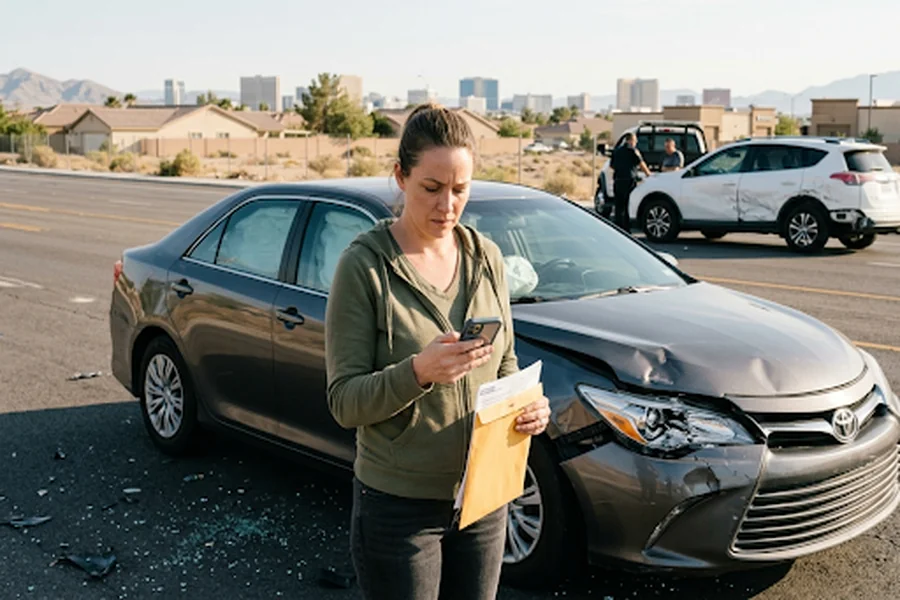
You carry the state minimum because it’s legal and it’s cheap, and nothing bad has happened yet. Then someone runs a red light on Las Vegas Boulevard, or a distracted tourist rear-ends you on the 215, and you find out the hard way that “legal” and “adequately covered” are two very different things in Nevada.
This isn’t a rare story here. It’s a predictable one, and it usually traces back to the same gap: drivers who carry exactly what the law requires, assume that’s enough, and never check what’s actually sitting on their policy’s uninsured motorist line.
What 25/50/20 Actually Requires
Under NRS 485.185, Nevada requires drivers to carry at least $25,000 per person and $50,000 per accident in bodily injury liability, plus $20,000 in property damage liability. Insurance is verified electronically through the Nevada Liability Insurance Validation Electronically system, so the DMV knows in real time if your coverage lapses.
These limits went into effect July 1, 2018, replacing Nevada’s previous, even lower minimum. They cover what you owe someone else if you’re at fault. They do nothing for your own medical bills, your own vehicle, or an accident caused by a driver who’s carrying no insurance at all.
The First Gap: $25,000 Doesn’t Go Far in a Real Accident
A single ER visit with imaging and a short hospital stay can approach $25,000 before ongoing treatment is even factored in. If your accident involves more than one injured person, the $50,000 per-accident cap has to stretch across everyone, and severe injuries to two or three people can exhaust that number while bills are still coming in. This is true anywhere, but it matters more in a city with as much traffic density and tourist unfamiliarity with local roads as Las Vegas has, where multi-vehicle collisions on corridors like I-15 through the resort corridor aren’t rare.
The Second Gap: The One Most Drivers Don’t Know They’re Exposed To
This is the gap that gives this article its name, and it’s specific to how Nevada law handles uninsured and underinsured motorist coverage. Under NRS 690B.020 and NRS 687B.145, every auto policy issued in Nevada must include UM/UIM coverage, at limits matching your bodily injury liability, unless you specifically rejected it in writing on a form your insurer provided.
Here’s the part almost nobody knows: if there’s no valid signed rejection form on file, Nevada courts have held that a driver may still have UM/UIM coverage even if they believed they declined it, a principle known as constructive acceptance. That cuts both ways. Some drivers who think they’re covered actually signed the rejection years ago and aren’t. Others assume they opted out to save money and never actually did. Either way, you don’t know which side of that you’re on until you pull your declarations page and look for the line labeled UM or UIM, not guess based on what you remember signing five years ago at a renewal.
Given that roughly 1 in 9 Nevada drivers carries no insurance at all, based on recent Insurance Research Council estimates, this isn’t a theoretical gap. If an uninsured driver hits you on Boulder Highway or in Strip traffic and you don’t have UM coverage, or you have it at a lower limit than your liability coverage, you’re the one absorbing the cost of your own injuries.
Why Las Vegas Specifically Makes This Worse
Nevada’s uninsured rate is actually somewhat lower than neighboring states, but that doesn’t make Las Vegas an easy market to be under-covered in. Clark County combines heavy resident commuter traffic with a constant flow of out-of-town drivers unfamiliar with local roads, rental cars driven by people on vacation, and a litigation environment that tends to push claim costs upward compared to smaller Nevada markets. All three factors mean a Las Vegas accident is more likely to produce a claim that exceeds state-minimum limits than the same type of accident would in a quieter part of the state.
What Actually Closes the Gap
1.Pull your declarations page and find the UM/UIM line right now. Don’t rely on memory. Confirm whether you have it, and at what limit, before you assume anything.
2. Match your UM/UIM limits to your bodily injury liability limits, not to whatever lower amount got auto-selected at some point. If your liability is higher than your UM/UIM, you have a mismatch working against you.
3. Consider raising your bodily injury limits above 25/50. Moving from 25/50 to 100/300 typically costs far less than people expect relative to the added protection, and it closes the most common gap that leaves a driver personally on the hook after a serious crash.
4. Don’t assume a higher deductible is automatically the right move to offset a higher liability limit. Raising your comprehensive or collision deductible to $1,000 or more only makes sense if you actually have that amount sitting in savings. If you don’t, you’ve just traded a monthly savings for a bill you can’t pay when a claim happens.
5. Compare quotes before renewing on autopilot. Rates for the same coverage vary meaningfully between insurers in the Las Vegas market, and shopping for car insurance in las vegas options at higher limits than the bare minimum often costs less than people assume once they actually get quotes rather than guessing.
A Reasonable Baseline for Las Vegas Drivers
There’s no single right answer for everyone, but a common approach among Nevada agents is to carry at least 50/100 in bodily injury liability with matching UM/UIM, rather than defaulting to the 25/50/20 floor. That’s not a legal requirement. It’s a response to what a real accident actually costs once you account for medical inflation and the number of uninsured or underinsured drivers sharing the road with you.
Before You Renew
Nevada’s Division of Insurance has published guidance specifically on the state’s liability requirements and how UM/UIM re-selection works, which is worth reading directly if you’re unsure what your current policy actually contains. Pull your declarations page, confirm your UM/UIM status in writing rather than from memory, and decide deliberately whether the state minimum is actually enough for the roads you’re driving in Las Vegas. The gap between what’s legal and what’s adequate is real here, and it’s one you can close in the time it takes to read your own policy.