
360° Rotating Acrylic Pen Holder: Uses & Benefits
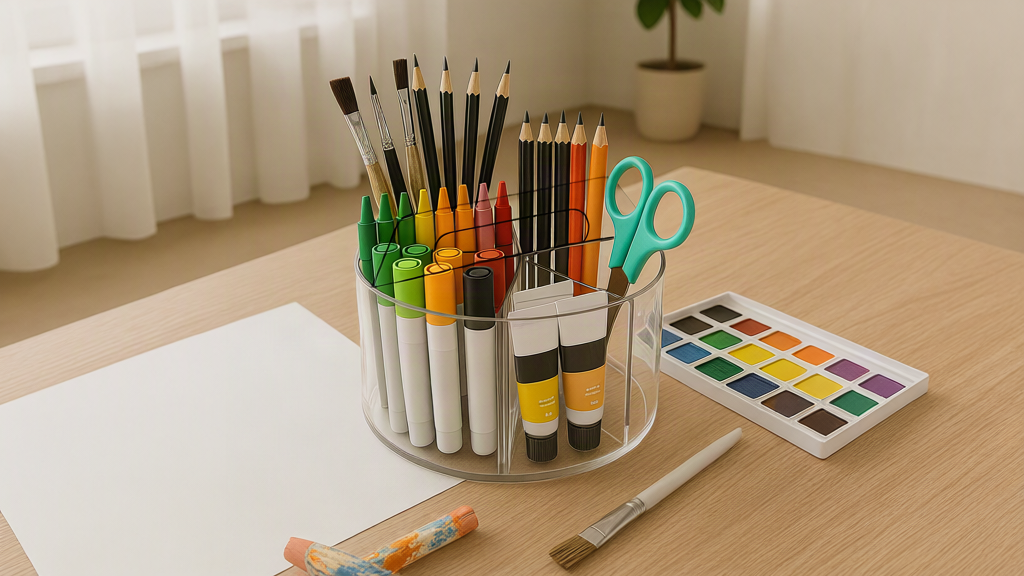
A well-organized desk is easier to work at, but the right organizer does more than simply keep supplies in one place. A 360° Rotating Acrylic Pen Holder combines transparent storage with an adjustable viewing angle, making pens, pencils, markers, brushes, and other small tools easier to see and reach. Its rotating base can be particularly useful when several people share supplies or when a workspace has limited room.
Acrylic is commonly used for desk organizers because it is lightweight, rigid, transparent, and relatively easy to clean. Unlike opaque containers, clear acrylic lets users identify what is inside without opening drawers or moving multiple containers. Understanding the material, design, capacity, and intended use can help you determine whether a rotating organizer makes sense for a home office, classroom, studio, reception desk, or professional workspace.
What Is a Rotating Acrylic Pen Holder?
A rotating pen holder is a desktop organizer designed to turn around a central axis. Instead of reaching around the container to find a particular writing instrument, the user can rotate the organizer until the desired item is accessible.
The rotating mechanism is usually mounted beneath the storage compartment. Depending on the design, the base may use a bearing, turntable mechanism, or another low-friction connection that allows smooth rotation.
The acrylic portion serves as the visible storage area. Because clear acrylic allows light to pass through, the contents remain visible from different angles. This can reduce the need to search through a closed container.
The concept is simple, but it solves a common desk-storage problem: accessibility. A conventional cup may work perfectly well when only a few pens are stored inside. Once the container becomes crowded, however, the items toward the back can become difficult to reach. Rotation changes the orientation of the organizer rather than requiring the user to move everything around.
Why Acrylic Works Well for Desk Organizers
Acrylic, also known as polymethyl methacrylate (PMMA), is a transparent thermoplastic often used as a lightweight alternative to glass. It is valued for its optical clarity, relatively low weight, and ability to be fabricated into different shapes.
For desktop organization, transparency is one of its biggest practical advantages. A clear container provides visual access to its contents, which is useful when the goal is to identify supplies quickly.
Acrylic can also be fabricated into compartments, trays, dividers, and holders with clean edges and precise dimensions. This makes it suitable for organizers designed around specific desk items rather than generic storage.
However, acrylic is not indestructible. It can scratch more easily than glass, particularly when cleaned with abrasive materials. Proper maintenance therefore matters if maintaining a clear appearance is important.
Common Uses Beyond Pens
Although writing instruments are an obvious application, a rotating organizer can hold many other small items. The usefulness largely depends on the size and shape of its compartments.
Home Office Supplies
A desk organizer can accommodate pens, mechanical pencils, highlighters, erasers, rulers, scissors, sticky notes, and other frequently used accessories. A rotating design can be useful on compact desks where every inch of working space matters.
Rather than keeping several small containers scattered across a workspace, users can consolidate commonly used supplies into one accessible location.
Art and Craft Materials
Artists and crafters often work with collections of small tools. Depending on compartment dimensions, an acrylic organizer may hold paintbrushes, colored pencils, markers, craft tools, or other lightweight supplies.
For this application, the depth of the compartments becomes particularly important. Long brushes or tools need enough vertical clearance to remain stable without making the organizer top-heavy.
Classroom and Shared Workspaces
In classrooms, studios, and shared offices, accessibility can be more important than individual ownership. A rotating container allows users sitting around a table to access supplies without passing the entire organizer back and forth.
The same principle can apply to reception areas or collaborative workstations where several people regularly use shared writing materials.
Important Design Features to Consider
Not every rotating desk organizer is built for the same purpose. Dimensions and construction can have a significant effect on how practical it is.
Compartment Size
The first consideration is the size of the storage sections. A narrow compartment may be suitable for pens and pencils but less useful for scissors, thick markers, or craft tools.
A container that is too shallow can also become unstable when filled with long objects. Conversely, very deep compartments may make shorter items difficult to retrieve.
The ideal configuration depends on what you intend to store rather than simply how attractive the organizer looks.
Overall Footprint
Measure the available desk space before choosing an organizer. A rotating mechanism needs enough clearance to turn without hitting monitors, desk accessories, walls, or other objects.
For a small workstation, a compact footprint may be more valuable than maximum storage capacity.
Rotating Mechanism
Smooth rotation is more than a convenience. If the base catches, wobbles, or requires excessive force, the organizer can become frustrating to use.
A quality mechanism should allow controlled movement while keeping the storage section reasonably stable. The base should also remain level during normal use.
Material Thickness
Acrylic sheet thickness affects rigidity, weight, and resistance to bending. Thicker acrylic is generally more rigid, although the appropriate thickness depends on the dimensions and construction of the organizer.
For a small desktop accessory, extremely thick acrylic may provide little practical advantage while adding unnecessary weight and material.
Edge Finish
The edges of acrylic components may be saw-cut, routed, polished, or otherwise finished. Smoothly finished edges are generally more comfortable to handle and can improve the overall appearance of a transparent organizer.
Edge quality is especially relevant for organizers that are frequently moved or handled.
Acrylic vs. Other Pen Holder Materials
Acrylic is only one option for desktop storage. Wood, metal, glass, plastic, ceramic, and fabric organizers are also widely used.
Wood tends to provide a warmer, more traditional appearance and can be highly durable, but it is opaque. Metal can offer excellent structural strength but may add more weight and can obscure the contents. Ceramic holders can be attractive and stable but are susceptible to chipping or breaking if dropped.
Glass provides excellent optical clarity and a premium appearance, but it is heavier and can break when subjected to impact. Acrylic offers a combination of transparency and lower weight, which explains its popularity in many display and organization applications.
The right material ultimately depends on the environment, expected handling, appearance, and type of items being stored.
How to Keep Clear Acrylic Looking Clean
Clear acrylic should be cleaned carefully because scratches can permanently affect its appearance.
For routine cleaning, remove loose dust first and use a soft, non-abrasive cloth. A mild soap-and-water solution can be used when additional cleaning is necessary. The surface should then be rinsed or wiped appropriately and dried with a clean soft cloth.
Avoid abrasive powders, rough paper towels, scouring pads, and aggressive solvents unless the acrylic manufacturer specifically confirms compatibility. Certain chemicals can damage acrylic surfaces or cause crazing, a network of fine cracks that can develop under chemical or mechanical stress.
It is also better to avoid dragging the organizer across a desk. Small particles trapped beneath the base can act like abrasive material and create scratches.
How to Organize a Rotating Pen Holder Efficiently
Simply placing everything inside an organizer does not necessarily make a desk more efficient. Organization works better when frequently used items are positioned for easy access.
Pens and pencils can be grouped together, while highlighters, markers, scissors, or specialty tools can occupy separate sections. Items used daily should generally be placed where they can be reached quickly.
It can also help to avoid overfilling the compartments. Too many items can make the contents difficult to identify and may interfere with rotation.
A useful rule is to organize according to frequency of use rather than item type alone. If a particular marker is used every day, it should not be buried underneath tools that are rarely needed.
Is a Rotating Organizer Suitable for a Professional Desk?
A rotating organizer can work well in professional environments, but its usefulness depends on the workspace.
On a personal desk, the main benefit is convenient access. In a shared office, rotation can make common supplies accessible from multiple seating positions. In customer-facing environments, transparent acrylic can also make supplies visible without requiring labels on every compartment.
However, professional workspaces should avoid turning organizers into clutter collectors. If an accessory holds dozens of items that are rarely used, it can occupy valuable desk space without improving workflow.
The objective should be controlled storage: keeping frequently used tools visible and accessible while moving less frequently used supplies elsewhere.
Choosing the Right Acrylic Organizer for Your Workspace
Before purchasing or building a desktop organizer, consider the actual objects it needs to hold. Count the number of pens, pencils, markers, brushes, or tools that you regularly use. Then consider their length, diameter, and weight.
Next, assess the available desk area. A large organizer may provide more storage but can become inconvenient on a compact workstation.
The rotating function should also solve a real accessibility problem. If the organizer will only hold three or four pens directly in front of you, rotation may offer little benefit. If multiple compartments need to be accessed from different directions, the feature becomes considerably more useful.
Conclusion
Acrylic desktop organizers combine visibility, lightweight construction, and flexible fabrication. Adding a rotating base addresses another practical issue: access from different directions. The result can be useful in home offices, classrooms, studios, reception areas, and shared workspaces where small supplies need to remain organized and easy to reach.
The best choice depends less on appearance than on the objects being stored, available desk space, compartment dimensions, material thickness, edge finishing, and quality of the rotating mechanism. A well-designed 360° Rotating Acrylic Pen Holder should make supplies easier to locate without creating another source of desk clutter.
For anyone comparing desktop storage options, these practical factors provide a better basis for selection than simply choosing the largest organizer or the one with the most compartments.