
Best Travel Stroller for Flying Canada 2026: Carry-On, Gate-Check & Airline Rules
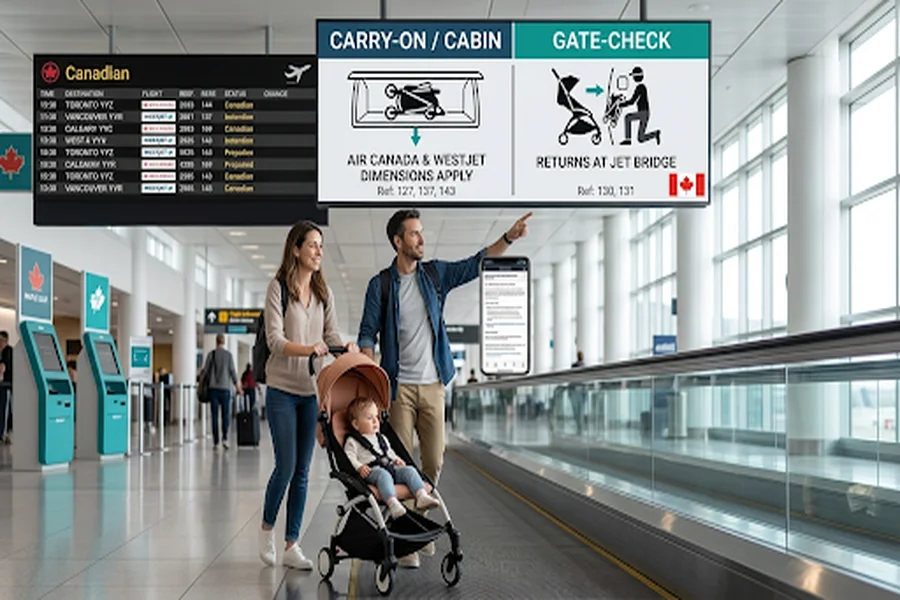
You’ve booked the flights. You’ve packed the snacks. Then the real question hits: do you bring the stroller into the cabin, or hand it off at the gate and hope for the best? For Canadian parents flying in 2026, the answer isn’t always obvious — and the wrong call can mean a damaged stroller, a delayed boarding, or an exhausted toddler with nowhere to sit.
This guide cuts through the confusion. Here’s exactly how carry-on, gate-check, and airline rules work in Canada — and what to look for in a lightweight travel stroller before you fly.
Carry-On vs. Gate-Check: What’s the Actual Difference?
Carry-On (Cabin) Strollers
A carry-on stroller goes with you into the aircraft cabin and fits in the overhead bin. No separation from your gear, no waiting at baggage claim, no risk of cargo hold damage. IATA recommends a maximum cabin baggage dimension of 56 cm × 45 cm × 25 cm — Air Canada and WestJet broadly align with this standard, though both carriers may require gate-checking if overhead space runs out. Even a cabin-approved stroller isn’t guaranteed bin access on every flight.
Gate-Check Strollers
With gate-checking, you use the stroller right up to the aircraft door, fold it, and hand it to the ground crew before boarding. It travels in the cargo hold and is returned to you at the jet bridge on arrival — usually before baggage claim. Most Canadian airlines allow strollers to be gate-checked free of charge as an additional item. The catch: cargo handling is rougher on regional turboprop aircraft. A stroller travel bag reduces this risk significantly.
Air Canada & WestJet: What the Rules Actually Say
Air Canada
Air Canada allows one stroller per child to be checked free of charge at check-in, the gate, or the aircraft door. For cabin storage, carry-on size limits apply: 23 cm × 40 cm × 55 cm. On Air Canada Express regional routes — operated on Dash 8 or CRJ aircraft — overhead bins are considerably smaller. A stroller that fits on a mainline jet may still need to be gate-checked on a regional flight. Always check your aircraft type when booking if cabin storage is a priority.
WestJet
WestJet accepts strollers as free checked items and allows gate-checking at no charge. Carry-on dimensions: 23 cm × 41 cm × 51 cm. WestJet Encore regional aircraft carry the same smaller-bin caveat. Both carriers recommend taking a screenshot of the stroller policy for your booking date — having written confirmation at the gate helps prevent disputes if a crew member is unfamiliar with current rules.
What to Look for in an Airplane Travel Stroller
If you’re shopping for a travel stroller for airplane use specifically, these specs matter most:
- Folded dimensions under 56 cm × 45 cm × 25 cm — the IATA carry-on reference standard
- Weight under 7 kg (approx. 15.5 lbs) — easier to lift into overhead bins solo
- One-hand or one-motion fold — essential when holding a child at the boarding gate
- Included carry bag or shoulder strap — protects during gate-checking and aids terminal carrying
- Self-standing fold — so it doesn’t topple while you handle boarding passes and carry-ons
Travel strollers for airplanes in Canada that consistently hit these marks include the Babyzen YOYO, Bugaboo Butterfly 2, UPPAbaby Minu V3, Cybex Libelle, and Silver Cross Jet. The differences between them come down to weight, seat depth, and terrain performance once you land.
The Gate-Check Decision: When to Skip the Overhead Bin
Even if your stroller qualifies as carry-on size, gate-checking is sometimes the smarter call:
- You’re flying with two carry-ons and a diaper bag — the stroller takes up overhead space you need
- You’re on a short domestic route where the stroller is returned at the jet bridge within minutes
- You’re on a regional aircraft with limited overhead space
For international trips with tight connections, keeping the stroller in the cabin removes a real variable — a gate-checked stroller can occasionally miss a connecting flight. For a full breakdown of IATA measurements and airline policies, the complete guide on carry-on and gate-check rules is worth reviewing before you travel.
Protecting Your Stroller in the Cargo Hold
If gate-checking, fold the stroller fully and secure any loose parts — canopies and bumper bars are the most vulnerable. A stroller travel bag adds meaningful protection. Remove cup holders and accessories that could snag, and take a quick photo of the folded stroller before handing it over. It takes seconds and provides documentation if anything is damaged on the other end.
The Bottom Line for Canadian Families in 2026
The best airplane travel stroller is the one that fits your specific route, aircraft, and travel style. For mainline Air Canada or WestJet flights on full-size jets, a cabin-approved lightweight travel stroller under 7 kg is a genuine time-saver. For regional routes on smaller aircraft, a well-protected gate-checked stroller is often easier — and it’s back in your hands at the jet bridge before baggage claim.
Know your aircraft type, screenshot the airline’s policy before you fly, and choose a stroller that folds and can be carried with one free hand. On travel day, that preparation matters more than any feature comparison.
Are you planning to carry on or gate-check on your next trip — and which Canadian carrier are you flying? Share your experience in the comments. It helps other parents know exactly what to expect on their specific route.