
Picking Educational Toys Kids Still Use After Christmas
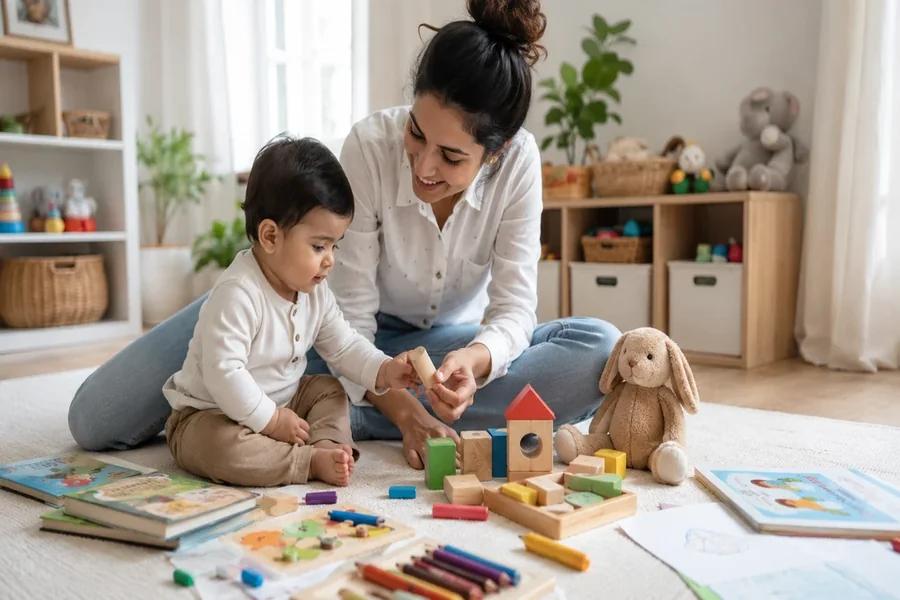
The toys children still play with in March are the ones that can be used in more than one way and that do not tell the child what to do. Open-ended building sets, art materials, simple construction kits and good board games consistently outlast electronic toys with a single function, because a child can bring a new idea to them at five, at seven and at nine. If a toy has one correct outcome, it has a shelf life measured in days.
The mismatch happens at the moment of buying. Under a tree, a toy that lights up, talks and demonstrates itself in the shop looks impressive, while a wooden marble run or a box of magnetic tiles looks quiet. Play researchers have long observed that toys doing most of the work leave the child with less to do, and less to do means less reason to come back. The boring looking box usually wins the year.
What Makes a Toy Survive Past January
Ask one question before buying: how many different things can a child do with this? A set of 100 wooden blocks has effectively unlimited outcomes. A plastic tablet that quizzes a four year old on animal sounds has one, and the child masters it inside a week. Toy industry data and parent surveys have repeatedly shown that a small fraction of gifts account for most of the actual play hours in the following months.
The second test is whether the toy grows. A good set can be used badly by a three year old (stacking, knocking down) and cleverly by a seven year old (bridges, symmetry, a garage for cars), so it survives developmental jumps instead of being outgrown. Toys pitched precisely at one age band, particularly ones with a printed range like “for 4 to 5 years”, are usually telling you the truth about their lifespan.
The third is whether it invites a second person. Games, construction sets and craft materials pull in a sibling or a parent, and social play is stickier than solo play by a wide margin. A single player electronic device is competing with a screen, and it will lose.
Finally, check whether it can break gracefully. A wooden train track missing two pieces still works. A battery robot with a snapped hinge is finished. Repairability is a genuine predictor of longevity, and it is the reason a lot of families still have blocks from a previous generation and none of the electronic toys from three Christmases ago.
The Categories That Actually Hold Up
Construction is the strongest category by some distance. Magnetic tiles suit ages roughly 2 to 8, wooden blocks span 1 to 10, and interlocking brick systems take over from about 5 upward and often keep going into the teens. A 100 piece magnetic tile set runs about CHF 60 to CHF 120 and gets used, in most households, several times a week for years, which is a very low cost per hour of play.
Art and making materials are the underrated ones. A proper set of pencils, paper, tape, glue, scissors and cardboard costs under CHF 50 and never expires, because the child supplies the idea each time. Add real tools as they grow: a child sized sewing kit at seven or eight, a modelling clay set, a hot glue gun with supervision around nine or ten. Consumables need topping up, which is actually an advantage since a birthday refill costs almost nothing.
Board games deliver an unusual amount per franc. Cooperative games work well from around four, roll and move games from five, and strategy games from about seven, and a good game gets fifty or a hundred plays over its life at a purchase price of CHF 25 to CHF 50. They also produce the thing parents most want from a gift, which is an hour at a table with the child rather than an hour of the child alone.
Science and engineering kits split into two types, and the distinction matters. Kits that build one model and are then finished get a weekend. Systems (electronics sets with reusable components, microscopes, robotics platforms that can be reprogrammed) get years, and cost CHF 80 to CHF 250 accordingly. If the box shows one finished object, expect one finished object.
Matching the Toy to the Child, Not the Age Label
Age recommendations on packaging are safety guidance about choking hazards first and developmental guidance second, so treat them as a floor rather than a target. A cautious six year old may want the four year old’s version, and a determined four year old may be ready for something labelled seven plus with an adult nearby. Watch what the child does unprompted for a week before deciding.
The strongest signal is the current obsession, and the trick is to buy sideways from it rather than directly into it. A child fixated on dinosaurs does not necessarily need another plastic dinosaur, but they might use a dig kit, a picture encyclopaedia, a set of blocks to build a habitat or a dinosaur themed board game for a long time. Buying directly into an obsession usually adds to a pile. Buying adjacent to it adds a new way to play.
Space and household reality also filter the list. A flat with no floor room cannot absorb a large marble run or a play kitchen, and Swiss apartments with limited storage often do better with things that fit a shelf or a cloth bag. Multi child households should weight toward shared systems (one big brick set, one game shelf) rather than parallel individual toys, which reduces both cost and the arguments.
Budget tiers matter less than people assume. Under CHF 30 buys excellent games, art supplies and small construction sets. The CHF 60 to CHF 150 band covers most of the genuinely long lived building systems. Above CHF 200 you are usually buying either furniture sized items or programmable electronics, and the failure rate at that price point is higher because the toy is more specific. When you are comparing options in the toys and games ranges on pandaloo.ch or anywhere else, sort by what the child does with the thing rather than by price, because the expensive box is not reliably the one still in use in spring.
Where and How to Buy Without Wasting Money
Check the safety marking before anything else. Toys sold legally in Europe carry the CE mark, and for Switzerland the same EN 71 standards apply in practice, covering mechanical safety, flammability and chemical limits. Very cheap imports bought from marketplaces sometimes carry a lookalike mark, and small magnets or long cords on unmarked toys are the specific hazards worth avoiding.
Buy fewer, better things and spread them out. Four thoughtful gifts get more attention than nine, and psychologists studying play have noted that fewer available toys tends to produce longer, deeper play sessions rather than less. Holding two or three gifts back for February, when the novelty of Christmas has worn off and the weather is still bad, works remarkably well.
The secondhand market is strong for exactly the toys worth owning. Wooden blocks, brick sets and board games survive multiple owners, and buying them used at half price on a local platform reduces the sting if a particular child turns out not to care. Check that games have all their pieces and that any electronics have accessible battery compartments with no corrosion.
Before you buy anything this year, take ten minutes to look at what your child actually played with over the last three months, not what they asked for. The pattern is usually clear and rarely matches the wish list, and the gift that gets used until summer is almost always a variation on something already working. If you get that wrong, the fallback that never fails is a large roll of paper, a box of tape and an empty cardboard box, which has beaten expensive toys in more households than anyone selling toys would like to admit.