
Round Tempered Glass Table Top: Thickness, Safety & Uses
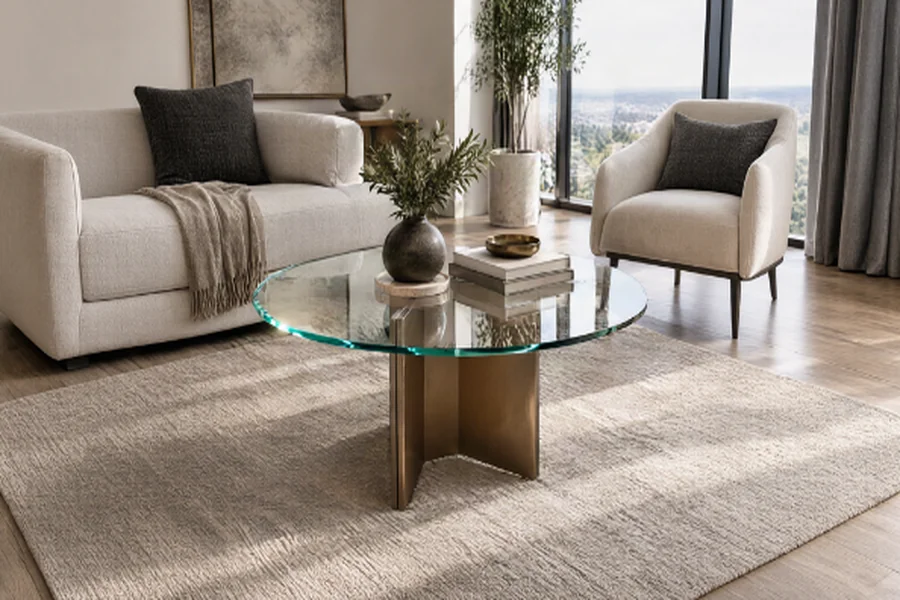
A glass tabletop can change the appearance of a room without making the furniture feel visually heavy. Round tempered glass table top designs are especially useful where smooth circulation, compact footprints, and a more social seating arrangement matter. But choosing a glass top is not simply a matter of picking a diameter and thickness. The glass type, support underneath it, edge treatment, intended use, and installation all affect how well the finished table performs.
For most table applications where safety is a priority, tempered glass is worth understanding. ASTM International’s ASTM F2813-18(2023) specifically addresses glass used as unenclosed horizontal surfaces in desks and tables and calls for laminated or tempered safety glass meeting applicable performance criteria.
This article explains the main factors to consider when selecting a round glass tabletop, including thickness, strength, edge finishes, support requirements, maintenance, and common mistakes.
Why Use Tempered Glass for a Tabletop?
Tempered glass is heat-treated to increase its resistance to mechanical and thermal stresses. According to the National Glass Association, tempered glass is approximately four times as strong as annealed glass of the same thickness, and when it does break, its fracture pattern is considerably smaller than that of annealed glass.
That distinction matters for furniture. A tabletop is exposed to everyday impacts from dishes, objects, chairs, cleaning equipment, and people. Tempering does not make glass impossible to break, but it changes how the glass behaves when breakage occurs.
ASTM F2813 specifically recognizes tempered safety glass as one of the appropriate glass types for unenclosed horizontal table and desk surfaces under 44 inches in height.
Choosing the Right Glass Thickness
Thickness is one of the most important decisions when replacing or creating a tabletop. Common options available for round glass furniture include 1/4 inch, 3/8 inch, and 1/2 inch, although the appropriate thickness depends on the diameter, support arrangement, intended use, and design of the furniture. Current U.S. glass tabletop listings show all three thicknesses being used across different round tabletop sizes.
A 1/4-inch top can provide a relatively low-profile appearance and may be appropriate when the glass is properly supported. Larger surfaces or furniture designs with different support conditions may call for thicker glass. For example, current custom tabletop listings include 60-inch and 72-inch round tops in 1/4-inch tempered glass, while other configurations are offered in 3/8-inch and 1/2-inch thicknesses.
The mistake is assuming that thickness alone determines safety or load capacity. It does not.
Glass stiffness, support spacing, diameter, edge condition, and how the tabletop transfers its load to the base all matter. A thicker piece of glass placed on a poorly designed or unstable base is not automatically a safe table.
1/4-Inch Glass
Quarter-inch glass is commonly used for smaller and appropriately supported tabletops. It creates a relatively light visual profile and is available in numerous round diameters.
For larger tabletops, however, buyers should not select 1/4-inch glass simply because it is cheaper or looks slimmer. The support system and intended application need to be evaluated together.
3/8-Inch Glass
Three-eighths-inch glass provides additional thickness and is commonly offered for dining tables, coffee tables, replacement tops, and other furniture applications. U.S. custom glass suppliers currently list 3/8-inch tempered round tops across a range of diameters and edge finishes.
It can be a practical middle ground when a tabletop needs more substantial construction without moving to a very heavy 1/2-inch profile.
1/2-Inch Glass
Half-inch glass is substantially heavier and creates a more substantial appearance. It is frequently available for larger round tops and furniture applications where the additional material thickness fits the design and support system.
The important point is that 1/2-inch should not be treated as universally “better.” A tabletop should be specified according to its dimensions and support conditions rather than thickness alone.
Diameter Matters More Than Many Buyers Expect
The diameter of a round tabletop directly affects its surface area, weight, seating capacity, and structural requirements.
A 24-inch top is dramatically different from a 48-inch or 60-inch top even though they share the same circular shape. As diameter increases, the amount of glass increases rapidly because the area of a circle is calculated using πr².
That means doubling the diameter does not merely double the surface area—it increases it by a factor of four.
This is one reason large round dining tables require more careful consideration of thickness and support. Current U.S. tabletop suppliers offer round sizes ranging from small 18-inch tops to very large 60-inch and 72-inch surfaces.
Before ordering replacement glass, measure the diameter at several points rather than assuming the existing tabletop is perfectly circular. If the old glass is still available, it can also serve as a useful dimensional reference.
Edge Finishes Are More Than a Design Detail
The edge of a glass tabletop deserves as much attention as the surface. A flat polished edge produces a clean, straight profile and is commonly used for contemporary furniture. A pencil-polished edge has a softer, rounded profile that can be more comfortable to touch. A beveled edge creates an angled transition between the top surface and the outer perimeter, giving the tabletop a more decorative appearance.
These finishes are available across current U.S. custom round tabletop offerings. Edge finishing also matters during handling. Sharp, unfinished glass edges are not appropriate for normal furniture use. Polishing removes the sharpness associated with a cut glass edge and produces a finished perimeter.
However, an edge finish should not be confused with a guarantee that the glass cannot break. Tempered glass remains glass and can fracture under sufficient impact.
How the Base Affects Glass Tabletop Performance
The glass itself is only one part of the table. A tabletop needs an appropriate support structure underneath it. Depending on the furniture design, support may come from a central pedestal, multiple supports, a perimeter frame, or another engineered base.
The distribution of those supports matters because glass can flex under load. The National Glass Association notes that glass deflection must be considered in glass design, and the stiffness behavior of glass depends on thickness and dimensions rather than simply whether it is annealed, heat-strengthened, or fully tempered.
This is why a tabletop should not be treated like a piece of wood that can simply span any distance.
A large circular top sitting on a small central support has different structural demands from a smaller top resting on a continuous frame. When replacing an existing top, the safest approach is to consider the original support design rather than changing the diameter or support arrangement without evaluation.
Tempered Glass Cannot Be Cut Afterward
One of the most important facts to understand before ordering tempered glass is that it cannot simply be modified after tempering.
ASTM C1048-25 states that fabrication such as cutting, edgework, drilled holes, notching, grinding, sandblasting, and etching must be completed before the glass is strengthened or tempered.
That means measurements need to be correct before fabrication.
If a tabletop needs a center hole for an umbrella, mounting hardware, or another feature, that opening must be specified during fabrication. Trying to drill the hole later can cause the tempered glass to break.
This is particularly important for replacement projects. Do not order a finished tempered tabletop with the expectation that a local glass shop can simply cut it down afterward.
Round Glass Tabletops for Different Furniture Types
Round glass tabletops are used across several furniture categories because the shape works well in both residential and commercial environments.
For dining tables, the circular shape can create a more conversational seating arrangement because there is no defined head of the table. Round dining tables are also useful where people need to move around the furniture from multiple directions.
For coffee tables, a circular glass top can soften rooms dominated by rectangular furniture. Smaller round tops are also frequently used for accent tables and side tables. Current U.S. listings include round glass tops specifically intended for coffee tables, dining furniture, desks, and other furniture applications.
Glass can also be used as a protective overlay on an existing table. In that application, the glass helps shield an underlying surface from spills, scratches, and everyday wear while keeping the original furniture visible.
Clear Glass vs. Decorative Glass
Clear glass remains popular because it allows the base or underlying furniture surface to remain visually prominent. This is particularly useful with sculptural bases, wood tables, stone surfaces, and decorative furniture.
Other options include tinted, colored, patterned, or printed glass. The right choice depends primarily on the visual purpose of the tabletop rather than structural performance alone.
When comparing glass types, avoid assuming that appearance tells you whether the glass is tempered. Tempering is a manufacturing treatment and should be confirmed through the product specification or fabrication documentation.
How to Clean and Maintain a Glass Tabletop
Glass is relatively straightforward to maintain, but improper cleaning can still create problems over time.
Use a soft, non-abrasive cloth with an appropriate glass cleaner or mild cleaning solution. Avoid abrasive powders, rough pads, and tools that could scratch the surface.
Do not drag ceramic dishes, metal objects, or decorative items across the glass. Even though tempered glass is stronger than comparable annealed glass, its surface can still be scratched.
Pay particular attention to the edges. The perimeter should not be subjected to unnecessary impacts from hard objects because the edge can be a vulnerable area of a glass sheet.
What Happens If Tempered Glass Breaks?
Tempered glass is designed to provide a different break pattern from annealed glass, not to eliminate breakage.
The National Glass Association explains that tempered glass breaks into a considerably smaller pattern after impact than similar annealed glass, reducing the potential severity of cutting injuries. The distinction is important: safety glass is not the same thing as unbreakable glass.
Laminated glass is another safety-glass option. Unlike monolithic tempered glass, laminated glass uses an interlayer between glass lites that helps retain fragments after breakage. The National Glass Association identifies laminated glass as another type of glass suitable for furniture applications.
For certain furniture designs or applications where fragment retention is particularly important, laminated glass may therefore deserve consideration.
Measuring for a Replacement Tabletop
Accurate measurements should be taken before fabrication. For a round replacement top, measure the diameter across the table in several directions. If the measurements differ, the original surface may not be perfectly circular.
Also examine the base. Determine whether the glass sits directly on supports, uses suction cups or protective pads, rests inside a frame, or connects to hardware through drilled holes.
Do not assume that the diameter alone gives the fabricator enough information.
The edge treatment, thickness, glass type, holes, cutouts, and support arrangement may all need to be specified before production.
Conclusion
Selecting a round tempered glass table top is ultimately a combination of geometry, material selection, support design, and safety considerations. The correct diameter and thickness depend on the furniture rather than on a universal rule that applies to every table. The most important questions are straightforward: How large is the tabletop? How is it supported? What will it be used for? Does it need holes or cutouts? What edge finish fits the furniture? And does the glass specification meet the applicable safety requirements?
For U.S. furniture applications, ASTM F2813 provides a useful technical reference because it specifically addresses glass used as horizontal surfaces in tables and desks. The biggest mistake is treating glass as a purely decorative material. A tabletop is a structural component of furniture, and its dimensions, support system, fabrication, and safety characteristics need to be considered together. Getting those fundamentals right matters far more than choosing a particular edge style or appearance.