
AI SDLC: How Artificial Intelligence Is Transforming Modern Software Development
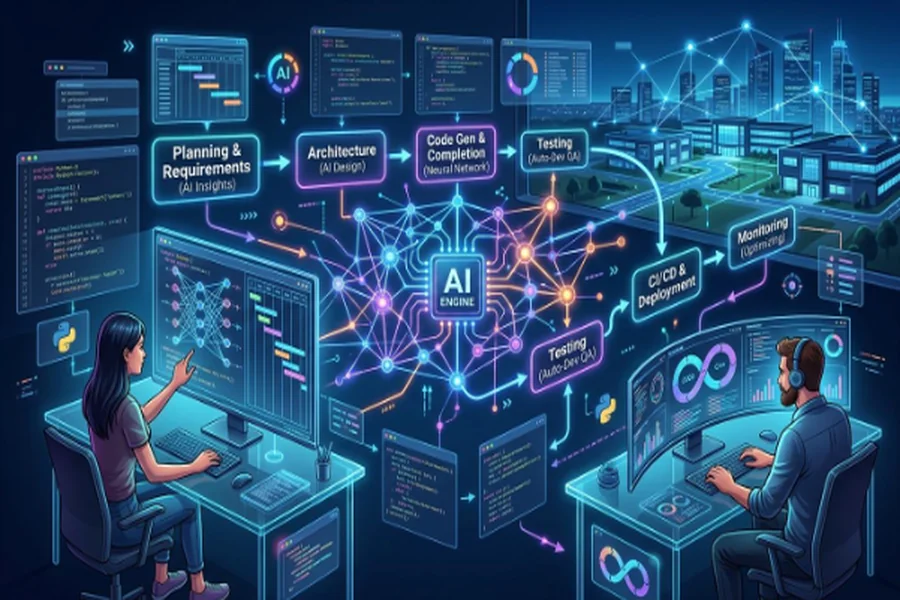
Software development has never been a completely linear process. Developers write code, run tests, fix bugs, review changes, rebuild applications, and repeat the process many times before a product is ready. As applications grow and teams become more distributed, even small delays can add up quickly.
Artificial intelligence is changing how teams approach this process. AI can help developers generate code, identify potential problems, write tests, analyze logs, and automate repetitive tasks. But its impact goes beyond writing code. AI is also influencing the infrastructure and workflows that support the entire software development lifecycle.
An AI-driven software development lifecycle connects development practices with automation, intelligent tools, and scalable infrastructure. The result can be a faster, easier-to-manage development process without removing the human decisions that still matter.
Microfrontends and Micro Front Ends in an AI-Driven Software Development Lifecycle
Large web applications can become difficult to maintain when every part of the frontend is connected to one massive codebase. A small change in one area may affect several unrelated components, slowing development and testing.
This is one reason teams use microfrontends. The idea is similar to microservices, but it applies to the frontend. Instead of building one huge interface, developers divide the application into smaller sections that they can develop and maintain independently.
For example, an ecommerce platform could have separate frontend components for product search, checkout, customer accounts, and recommendations. Different teams can work on these areas without constantly modifying the same codebase.
AI can make this approach more practical by helping developers manage the additional complexity.
AI tools can assist with:
- Generating components and basic frontend code based on existing patterns.
- Detecting inconsistencies between independent frontend modules.
- Suggesting tests for individual components.
- Analyzing code dependencies and identifying potential integration problems.
The goal is not to let AI design the entire frontend without supervision. Developers still need to decide how components should communicate and how the overall user experience should work.
Micro frontends are especially useful for organizations where several teams work on different parts of a large digital product. AI can help these teams move faster while still keeping individual areas relatively independent.
As applications grow, this combination of modular architecture and AI-assisted development can make it easier to introduce changes without turning every update into a large project.
Build Systems: How AI Is Improving Software Build Processes
Once developers make changes to an application, they need to compile, package, test, and prepare those deployment changes. In small projects, this process may take only a few seconds. In large projects, it can waste significant time.
Modern build systems make this process more efficient. They determine what to rebuild, manage dependencies, and organize the steps needed to produce the final software.
AI adds another potential layer of optimization. Instead of relying only on predefined rules, AI-assisted tools can analyze previous builds and identify patterns in how projects behave.
For example, a system may notice that certain files rarely change or that particular tasks frequently run in parallel. This information can help developers optimize build pipelines and reduce unnecessary work.
AI can also help investigate failed builds. Rather than forcing a developer to search through hundreds of lines of logs, an AI assistant can summarize the failure and point toward the most likely source of the problem.
Effective build systems can provide several practical benefits:
- Faster feedback when developers make changes.
- Better use of computing resources.
- Fewer unnecessary rebuilds.
- Easier identification of failed or inefficient build steps.
However, faster builds are not only about speed. Developers need reliable and predictable results. An extremely fast build that produces inconsistent artifacts creates more problems than it solves.
This is why AI should support existing engineering practices rather than replace them. Teams still need clear build rules, reproducible environments, automated testing, and reliable deployment processes.
Toolchains: Building More Efficient AI-Enabled Development Workflows
Developers rarely use a single tool. A typical project may involve a code editor, programming language, package manager, testing framework, build system, version control platform, CI/CD service, monitoring solution, and cloud infrastructure.
Together, these tools form a development toolchain environment. When the tools work well together, developers can move smoothly from writing code to testing and deployment. When they do not, engineers may spend a surprising amount of time switching between systems and fixing integration problems.
AI can help connect these workflows.
An AI assistant can generate code inside an editor, explain a failed test, suggest a change, and help prepare a commit. Another AI-powered system may analyze deployment logs and identify a problem before a developer has to inspect every message manually.
The value comes from connecting these capabilities rather than treating AI as one isolated feature.
A practical AI-enabled workflow might look like this:
- A developer describes a feature and creates an initial implementation with AI assistance.
- Automated tests check the changes, and AI helps identify failures.
- The build system determines which parts of the project need rebuilding.
- Cached results are reused where possible.
- Remote infrastructure handles resource-intensive tasks.
- Developers review the final changes before deployment.
This approach reduces repetitive work while keeping developers responsible for architecture, security, quality, and key technical decisions.
Well-designed toolchains also make it easier to standardize development practices across teams. Instead of every developer creating a completely different workflow, organizations can provide a common environment with approved tools, automation, and security controls.
That becomes increasingly important as AI-generated code becomes more common. Teams need consistent testing and review processes to ensure faster development doesn’t lead to lower software quality.
Remote Cache: Accelerating Builds in Modern AI-Driven Development
Even an optimized build process can waste time if developers repeatedly perform work that someone else has already completed.
This is where a remote cache can help. Instead of storing build results only on an individual developer’s computer, a remote cache allows teams to share previously generated artifacts.
Imagine that one developer builds a large project component. If another developer makes changes that don’t affect that component, the second developer may be able to reuse the existing result instead of rebuilding from scratch.
A remote cache can help teams:
- Avoid repeating identical build operations.
- Reduce waiting time for developers.
- Use fewer computing resources.
- Speed up CI pipelines when previous results can be reused.
AI-assisted development can increase the number of code changes a team makes in a day. That makes build efficiency even more important. If developers generate and test more changes but have to wait several minutes after every update, much of the productivity benefit can disappear.
Caching helps by removing unnecessary work from the development cycle. Of course, caching needs to be configured carefully. Build inputs must be tracked correctly so an outdated result isn’t reused when the underlying code or dependencies change.
When implemented properly, caching becomes almost invisible to developers. They see faster feedback.
Remote Execution: Scaling Software Development With AI-Powered Infrastructure
Caching helps avoid repeated work, but some tasks still need to run. Large applications can require significant computing resources for compilation, testing, analysis, and other operations.
Remote execution allows these tasks to run on remote infrastructure instead of relying entirely on a developer’s local machine.
This can help developers working on laptops with different hardware configurations. A centralized execution environment can provide more consistent resources and make it easier to scale computing capacity when demand increases.
AI can also benefit from this infrastructure. AI-assisted development may involve computationally demanding tasks such as large-scale testing, code analysis, model evaluation, or automated security checks.
With remote execution, teams can move these workloads to infrastructure designed to handle them efficiently.
There are several practical advantages:
- Developers can work without needing extremely powerful local hardware.
- Teams can scale computing resources to match the workload.
- Build and test environments can be standardized.
- Resource-intensive AI tasks can run without slowing down local development.
The combination of remote cache and remote execution can be particularly effective. The cache prevents unnecessary work, while remote infrastructure handles what still needs to happen.
Together with modern build systems and connected toolchains, these technologies create a development environment that can respond more efficiently as projects grow.
The most important change AI brings to the software development lifecycle is not simply faster code generation. AI can influence how developers plan, build, test, troubleshoot, and maintain software.
Architectures such as microfrontends can help teams divide complex applications into manageable parts. Smarter build systems can reduce unnecessary work, while AI-enabled toolchains can connect more stages of development.
At the infrastructure level, remote cache can eliminate repeated builds, and remote execution can provide the computing power needed for demanding workloads.
The human role remains essential throughout this process. Developers still make architectural decisions, review generated code, evaluate trade-offs, and take responsibility for the software they ship.
AI is best understood as another capability layer within the development lifecycle. When it is combined with sound engineering practices and reliable infrastructure, an AI SDLC approach can help teams spend less time on repetitive work and more time solving the problems that actually require engineering judgment.